Get Your Body Healthy
Featured

Fast Weight Loss

May 12, 2009 by admin · Leave a Comment 

Fast weight loss sounds good to some, dangerous to others. However, what do well consider fast weight loss to be? I’m talking about losing in 2-3 weeks around 30 pounds of body fat. It takes a long time usually, for someone to get excess weight. It’s only natural that losing weight is just as slow. Expecting to lose too much, too fast, isn’t realistic. The good part is that it’s possible to lose the fat weight in a quicker manner than it took you to gain it. Losing 30 pounds of body fat in just 15 weeks is possible. If you think about it, that only means 2 pounds each week. If you gained 30 pounds in 3 years, getting rid of it in 15 weeks isn’t that bad.

It doesn’t mean that it’s going to be easy. Learn as much as you can about your own body, pick the right diet, exercise and burn as much energy as you can, get your motivation up and so on.

A lot of people, all over the world, have tried every single diet available out there. Some of them work, while others just ruin your health, even though they get rid of the extra weight. Attracted by the promises of false gurus, people spend a lot of money on programs that promise them that they’re going to lose a lot of weight and fast.

If all those people actually tried a normal diet, which helped them reduce weight while protecting their health, they might have much better success. I think that after trying all those fast solutions and failing, all people will end up using a normal diet, which will take care of their health and help them lose weight at a small but steady rate. Losing weight with the help of a regular diet will also allow the body to change the way it behaves.

Healthy Eating Guidelines

May 12, 2009 by admin · Leave a Comment 

Wherever you look in a supermarket, you will find a huge number of food types, all at your disposal to choose from. When you look at a menu, you will have a number of pages with food to choose from.

Also, you can see ads about food wherever you’re looking, gurus that offer you wonder diets, experts that warn you about every single health problem and so on. You can find information on food wherever you look.

Since there are so many sources of information, it can be hard sometimes to find information that is accurate, or to know which source of information to trust. What should you eat in order to remain healthy isn’t always an easy question to answer.

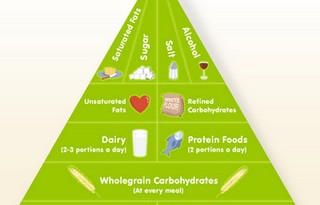
The main rule of healthy eating is doing everything in moderation. It’s actually at the top of the pyramid of all the rules. Whatever you’re eating, it should be done in moderation, and that is very important for your health. Obviously, eating too much of anything means that you risk becoming obese.

A great part of the reason why people become obese is that they’re not careful with the portions and sometimes continue eating even after their body signals them that they’re full. You should always pay attention to the portions you’re eating and eat your food slowly. Paying attention means that you know how much you’ve eaten and you don’t consume more calories than you should. Also, make sure you don’t ask for seconds, don’t get the largest meal available and don’t snack from boxes of cookies when you get them in your hands.

Learning what the portion sizes are can be a good initial step towards finding out how much calories you’re consuming. Most people will consume 3 or 4 times more food than the labels recommend for a daily dosage.

Counting Calories

May 12, 2009 by admin · Leave a Comment 

If you want to lose some weight, you probably know that you should be consuming less calories than your body needs. Reducing the amount of calories that are ingested shouldn’t be done all of a sudden. It should be done gradually, during a few weeks, not at once. A lot of people do it differently, cutting a huge amount of calories from their diet all of a sudden. Actually, counting your calories isn’t that important.

If you think about it, the number of variables that take place in your body is huge, so a possible diet inaccuracy will be compensated by daily activity and workload. A life that is active enough on a daily basis should be sufficient. One example would be when you burn around 2000 calories, but you consume only 1500. That difference of 500 calories means that you’re on your way to losing weight. Since you’re under the number of burned calories, it doesn’t really matter how many you consume.

The problem would be that in some days, the energy balance is reversed, and there is less energy burned. If you don’t burn all the energy that you need, it can happen because you had a long work day and you’re tired. It can also happen that an workout can consume less calories because your heart isn’t into it. Working at a lower intensity can mean that you no longer burn as many calories as you did before. That can make the difference between a day when you lose weight and a day when you put weight.

What you should do in this case, is adapt your diet, to compensate for the low intensity training. That means that the next day, I will consume less calories, to compensate for the previous day, eating only half of the usual portions.